Why the real constraint on an IT systems integrator's growth may not be headcount — but the disconnect between the sales pipeline, engineering skills and delivery capacity.
It's Monday morning at an IT systems integrator.
The sales team has landed a substantial deal. The customer is happy, the contract is signed, revenue is in the forecast, and the project is expected to kick off next month.
Across the business, the infrastructure lead is looking at the delivery schedule. Two engineers are finishing a complex migration. Another is handling a customer incident. A fourth is on leave. Several other projects are already committed.
Then comes the message: “Great news — we've won another project. We'll need two engineers for about three weeks. Can they start as soon as possible?”
Nobody has necessarily done anything wrong. Sales has done its job. The engineers are honoring existing commitments. Team leads are trying to balance competing priorities.
Yet the business has a problem: a commercial win has become a delivery commitment before anyone has established whether the right skills will actually be available.
That raises a more useful question than the familiar “Do we need more engineers?”: do we have a reliable way to connect what we're likely to sell with what we can realistically deliver?
Two Views of the Same Business
Most sales organizations have a fairly clear picture of their pipeline. CRM records capture deal values, sales stages, expected close dates and probabilities. Management uses the data to forecast revenue and assess growth.
But what does delivery know about those same opportunities?
Can it estimate how many network-engineering hours will be needed next month? Which opportunities are likely to require a virtualization specialist, a security architect or a storage engineer? Who will support the solution after go-live?
The answers may exist, but they are scattered across proposal spreadsheets, estimates, project plans, email threads and people's heads.
Sales plans in opportunities and revenue. Delivery plans in skills, effort, dependencies and time. Both are legitimate views. The trouble starts when they aren't connected.
For any meaningful infrastructure project, someone must estimate the work before pricing it: solution design, deployment, migration, testing, documentation and handover. Those estimates often feed into the commercial calculation. Why shouldn't they also inform the delivery forecast?
This is where demand management meets capacity management. One describes work likely to arrive; the other describes the skills and time available to perform it. Bringing them together turns a sales forecast into something operations can plan against.
One Simple Chart, Much Better Questions
Imagine a systems integrator with four engineering disciplines. For a single planning period, it estimates available delivery hours, work already committed and additional demand implied by its qualified pipeline.
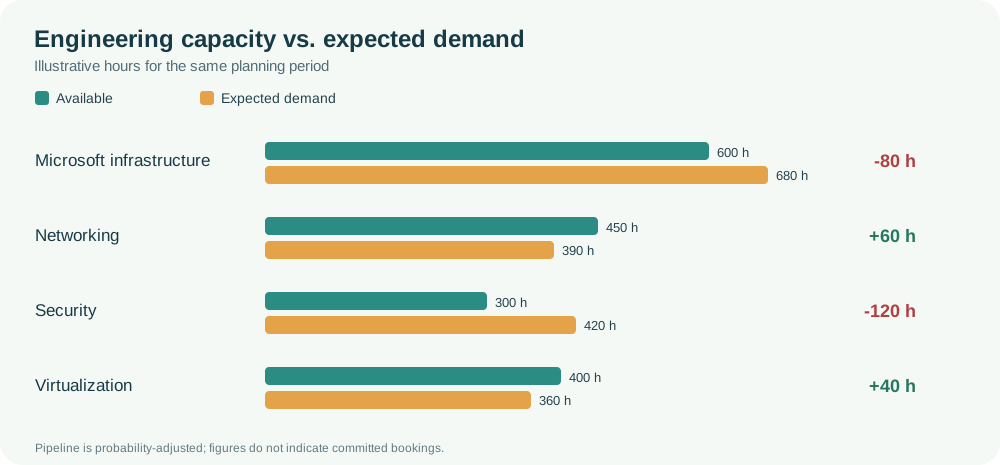
Illustrative figures only. Available hours are net of planned leave, recurring operational obligations and a reasonable contingency. Pipeline demand is probability-weighted, not a confirmed booking.
At first glance, the company appears to be 100 hours short: 1,850 hours of expected demand against 1,750 hours of capacity.
But the overall number hides the real story. Microsoft infrastructure faces an 80-hour expected shortfall and security faces a 120-hour shortfall. Network engineering and virtualization, meanwhile, have a combined 100 hours of potential headroom.
That's not simply a 100-hour staffing gap. It's 200 hours of pressure in two specific skill areas, partly offset by 100 spare hours elsewhere. And an available network engineer cannot automatically take the place of a security specialist.
Now management can ask better questions. Is the security capability genuinely understaffed? Can some work be rescheduled, automated or handled by a partner? Would cross-training help? Are the estimates accurate in the first place?
There's another catch: a probability-weighted pipeline is useful for forecasting, not for reserving half an engineer. If a deal with a 50% chance of closing actually closes, it may need a full team in a specific week. Sensible planning therefore combines expected demand with scenarios, delivery windows and known single points of expertise.
The chart doesn't prove that the business needs to hire. It shows what the business needs to investigate before it does.
Specialist Teams Aren't the Problem. Information Silos Are.
Systems integrators tend to grow around technical disciplines: data centers, networking, cybersecurity, Microsoft platforms, cloud services, business applications and more. That specialization is a strength. Customers need people who understand complex technologies deeply.
It becomes a weakness when specialization turns into isolation.
A network lead understands the team's workload but may have limited visibility into upcoming security or infrastructure projects. A project manager owns a deadline without controlling every specialist needed to meet it. Sales is negotiating new engagements while delivery hears about them only after the deal is almost done.
The result can be familiar: late starts, constant reprioritization, escalations and the same trusted experts being pulled into everything.
Some of those experts become informal bridges between departments, tools and processes. They are invaluable — but a business that depends on specific individuals just to move information around has a resilience problem as well as a talent advantage.
The first response needn't be a new org chart. A better place to start is the flow of information, decisions and ownership from a qualified sales opportunity through delivery and operational handover.
Team Leads Need a Shared Picture — and Clear Decision Rights
Picture a short, recurring planning conversation between sales, delivery management and engineering leads.
Sales flags major opportunities approaching a decision. Engineering leads validate the proposed skills, effort estimates and possible bottlenecks. Delivery management checks timing, dependencies, contractual obligations and priorities.
The point isn't another status meeting. It's to make decisions while there is still room to act: which dates can be committed, which bids need more technical validation, which specialists should be reserved and where outside expertise may be needed.
Information has to travel both ways. Sales needs early visibility of delivery constraints; engineering needs early warning of demand that may become real.
And somebody needs the authority to resolve competing priorities. Without clear decision rights, a company can build an excellent dashboard and still make exactly the same last-minute decisions as before.
Three Engineers. Three Different Hyper-V Clusters.
A second source of friction is less visible in capacity spreadsheets: inconsistent delivery practices.
Give three experienced engineers the same broadly comparable Hyper-V cluster requirement. All three might build technically sound systems. But they may choose different network settings, monitoring arrangements, documentation structures, validation steps and handover procedures.
That variation doesn't mean the engineers lack skill. Sometimes the differences are justified. But unnecessary variation increases operating costs, makes cross-team support harder and raises the risk of avoidable mistakes.
Customers aren't paying for three personal interpretations of a repeatable task. They're paying for a secure, supportable and predictable outcome.
For repeatable solutions, there should be reference architectures, validated configurations, delivery checklists, documentation templates and acceptance criteria. Engineers should still be able to depart from a standard when customer needs justify it — with a reason, appropriate approval and a documented exception.
Standardization isn't the opposite of innovation. It gives engineers a dependable baseline so that departures are deliberate rather than accidental.
A standard also needs an owner. Otherwise it's just another document everyone assumes someone else is maintaining.
Sell Delivery Capability, Not Just Technology
Markets move fast. Cloud platforms, security products, AI and automation keep creating opportunities no integrator wants to ignore.
But there's a difference between being able to quote a technology and having a credible plan to implement, support and maintain it.
For a new or unfamiliar offering, the sales process should surface a few questions early. Do we have the capability? Can we develop it before delivery starts? Will a partner be involved? Who owns the service after go-live? Which technical and commercial assumptions remain untested?
None of this argues for a timid sales organization. It argues for ambition with visibility.
Commercial agility and delivery discipline aren't opposites. Good delivery discipline makes it safer to pursue new business.
The Most Expensive Hours May Be the Ones You Don't See
An engineer may have 160 working hours in a month. That doesn't mean there are 160 hours available for new projects. Existing service commitments, incidents, change requests, peer support, training and improvement work all consume time.
Managed services are especially sensitive to this distinction. Unplanned work is part of the operating model. Commit every available hour to project delivery and one significant incident can disrupt several schedules at once.
Utilization is not the same as productivity, either. An engineer who spends time automating a repeatable deployment may create far more long-term value than someone who maximizes billable hours by doing it manually over and over again.
Better measurement looks beyond booked time: estimated versus actual effort, waiting time between teams, rework, handover quality, delivery predictability and the long-term economics of projects and services.
Start Small. Learn Fast.
None of this requires a company-wide restructure or a major software purchase on day one.
A focused pilot is enough to test the idea:
- Choose one or two engineering disciplines. Bring together committed work and significant opportunities for the next three months.
- Translate opportunities into effort and skills. Capture estimated hours, experience level, timing and close probability.
- Calculate realistic capacity. Account for leave, operational commitments and appropriate contingency.
- Create a regular decision forum. Let sales and technical leads agree on capacity risks, priorities and feasible commitments.
- Close the feedback loop. Compare estimates with actual effort and use the differences to improve future bids and plans.
After a few cycles, there should be better visibility — or at least a much clearer picture of which data, responsibilities and decisions are missing. Then the process can be refined, scaled and, where useful, automated.
A new tool can't rescue an undefined operating model. It can only make the same confusion easier to click through.
Maybe You Really Do Need More Engineers. Which Ones?
Skill shortages are real. Certain technologies require scarce expertise, some services need continuous coverage, and growth can absolutely justify additional hires.
But headcount should be a conclusion supported by evidence, not the default response to a sense that everyone is busy. Sometimes the right investment is another specialist. Sometimes it's better scheduling, stronger standards, better handovers or fewer repeat deployments done from scratch.
Systems integrators often succeed because they have exceptional individuals. The next stage of maturity is to turn their expertise into a delivery system that remains reliable when the most experienced person isn't available.
So perhaps the first question for leadership isn't “How many more engineers should we hire?”
It's this: “Do we genuinely understand the work we're about to commit to, the skills we have, and how efficiently we turn those skills into customer value?”
If the answer is uncertain, that's a very good place to start.